
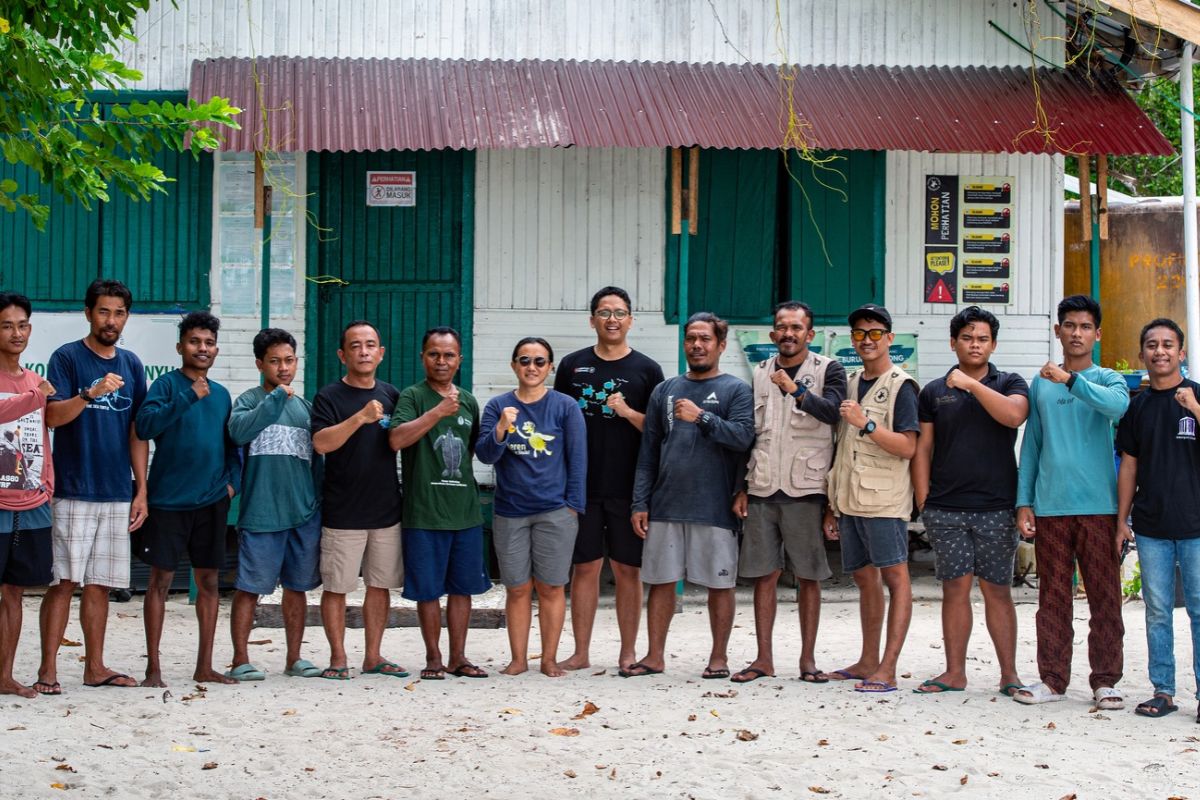
Sea turtle conservation requires more than knowledge and technical skills. It also depends on people who can put that knowledge into practice and share it with others to ensure long-term conservation efforts. With this in mind, Yayasan Penyu Indonesia (YPI) initiated a series of Training of Trainers (ToT) to strengthen the capacity of its conservation teams across Indonesia.
Following two previous training sessions, ToT I in Berau, East Kalimantan, in September 2024, and ToT II in Simeulue, Aceh, in February 2025, the programme entered its third and final stage. While the first two sessions focused on building participants’ knowledge and skills through presentations and hands-on activities, ToT III provided an opportunity to assess how this knowledge had been applied in the field and shared with team members at each project site.

From Knowledge to Practice
In ToT III, the focus shifted from acquiring knowledge to applying it and passing it on to others. Participants who had previously completed the training took on a new responsibility: becoming trainers for rangers in their respective project locations.
Activities were conducted over three to five days at each project site. Each training programme combined classroom presentations with practical field sessions. Training materials were adapted to local conditions, taking into account the sea turtle species found at each site, habitat characteristics, and the conservation protocols implemented in the area.
Through this approach, participants were expected not only to understand the training materials but also to deliver them effectively, lead practical sessions, and guide their teams in carrying out various sea turtle conservation activities.
Evaluating and Strengthening Local Trainer Capacity
Unlike the previous two training sessions, ToT III also served as an assessment of participants’ progress. With guidance from Meriussoni Zai (YPI’s Director of Science) and Adhith Swaminathan (YPI’s Scientific Advisor), the evaluation was conducted through visits to each project site.
The assessment focused on participants’ ability to deliver training materials, lead training sessions, and apply their knowledge and technical skills in field activities. Participants were also encouraged to adapt their training materials to the specific needs and challenges of their respective locations, ensuring that the knowledge shared could be applied effectively by their teams.
This process represents an important step towards building local capacity and independence. Having trained ranger trainers at each project site helps ensure that knowledge and skills continue to be shared, even when staff turnover occurs. In this way, the experience and expertise developed through the programme can become a shared resource rather than remaining with individual team members.
Keeping the Knowledge-Sharing Journey Going
The completion of ToT III does not mark the end of the learning process. Instead, it marks the beginning of a continued knowledge-sharing journey across YPI’s project sites.
Moving forward, capacity-building efforts will continue through regular mentoring and evaluations, alongside the development of a Ranger Handbook consisting of eight modules. The handbook is expected to serve as a practical guide for rangers in understanding and carrying out various aspects of sea turtle conservation, while also providing structured learning materials for local trainers to support future training sessions.
The Training of Trainers programme is part of a project funded by the UK Government through the Darwin Initiative, which aims to strengthen Yayasan Penyu Indonesia’s capacity to protect sea turtles and their habitats across Indonesia.
We believe that successful conservation is not determined solely by how much knowledge an individual possesses, but also by how that knowledge is applied, shared, and passed on to others. By strengthening the capacity of local trainers, YPI hopes to empower more people to take an active role in sea turtle conservation, ensuring that these efforts continue to grow and thrive across Indonesia.

