
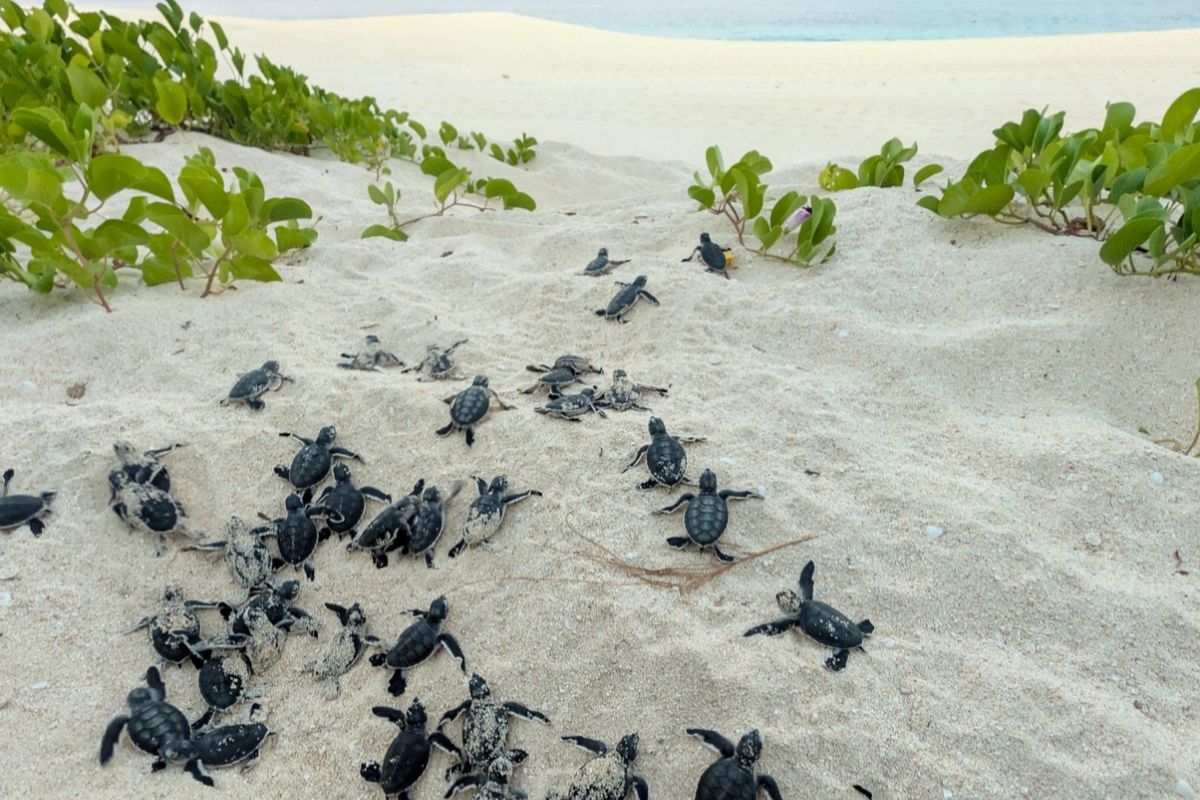
Pulau Salaut Besar is an uninhabited island covering 253 hectares, located off the coast of Sumatra. The island serves as an important nesting habitat for sea turtles. Three species have been recorded nesting here: green turtles, leatherback turtles, and hawksbill turtles. To protect sea turtle populations and their natural habitats, the ranger team from Yayasan Penyu Indonesia conducts patrols and monitoring activities on the island throughout the year.
One of the main focuses of conservation efforts is protecting sea turtle nests to maximize hatching success and ensure that hatchlings can reach the sea as soon as possible after emerging. In practice, each nest is managed according to its specific conditions and the level of threats at the nesting site.
Protecting Nests While Considering Natural Conditions
Not all sea turtle nests need to be relocated. When a nest is found in an area at risk of being affected by high tides, coastal erosion, or other threats, the eggs may be relocated to a hatchery (a designated incubation area managed to protect sea turtle eggs).
Meanwhile, if a nest is located in a relatively safe area with suitable environmental conditions, it will be left in its original location. Protection is provided through patrols, guarding, and regular monitoring to ensure that the nest remains safe.
83% of Nests Are Protected in Their Natural Locations
Data from January to July 2026 show that 83% of the green turtle nest protection efforts carried out by our team across four conservation islands involved keeping nests in their natural locations.
These sites include Pulau Salaut Besar in Simeulue, as well as Pulau Mataha, Pulau Bilang-bilangan, and Pulau Balambangan in Berau.
This figure demonstrates that when site conditions allow, nest protection does not always require relocation. Leaving nests where turtles originally laid their eggs, combined with regular monitoring and protection, is an appropriate approach to supporting the natural hatching process.
Why Should Natural Nests Be Preserved?
Keeping nests in their original locations allows hatchlings to experience the early stages of their lives through natural processes.
When hatchlings emerge from their nests, they instinctively display a behavior known as swimming frenzy, characterized by intense, directional swimming toward the open sea. This response is an important part of their natural mechanism for leaving the beach and reaching their marine habitat.
In addition, hatchlings undergo a process known as imprinting, in which they recognize and remember the characteristics of the beach where they hatch. This environmental information plays a role in helping sea turtles recognize their natal beach when they reach adulthood and return there to lay their eggs.
These natural processes are among the key reasons why nests should be preserved in their original locations whenever environmental conditions and safety levels allow.
An Important Energy Reserve for a Hatchling’s First Journey
When hatchlings emerge, they still carry an energy reserve in the form of a remaining yolk sac. This reserve plays an important role in supporting their initial activities, including swimming toward their first foraging habitat.
By allowing hatchlings to make their way directly to the sea after emerging from their nests, this energy reserve can be used to support their first journey into the marine environment.
Therefore, conservation success is not measured solely by the number of eggs that hatch, but also by how well the natural processes following hatching are allowed to take place.
Final Thought
Every nest has different conditions and faces different challenges. Therefore, protection efforts must take into account the characteristics of each location, potential threats, and the biological needs of sea turtles.
Relocation to a hatchery remains an important measure when nests face risks that could threaten hatching success. However, whenever conditions allow, preserving nests in their natural habitats is an approach that should be prioritized.
Through year-round patrols, regular monitoring, and nest management based on field conditions, Yayasan Penyu Indonesia strives to ensure that every nest receives the appropriate protection. Because in sea turtle conservation, protecting their survival also means giving nature the space to take its own course.

